Laxmi Vihar, Bhubaneswar, Odisha
Founder-Led Website, Software & ERP Development in Bhubaneswar, Odisha


Is your business outgrowing spreadsheets? Learn seven practical signs it may be time for custom software to organise work, data and reporting.
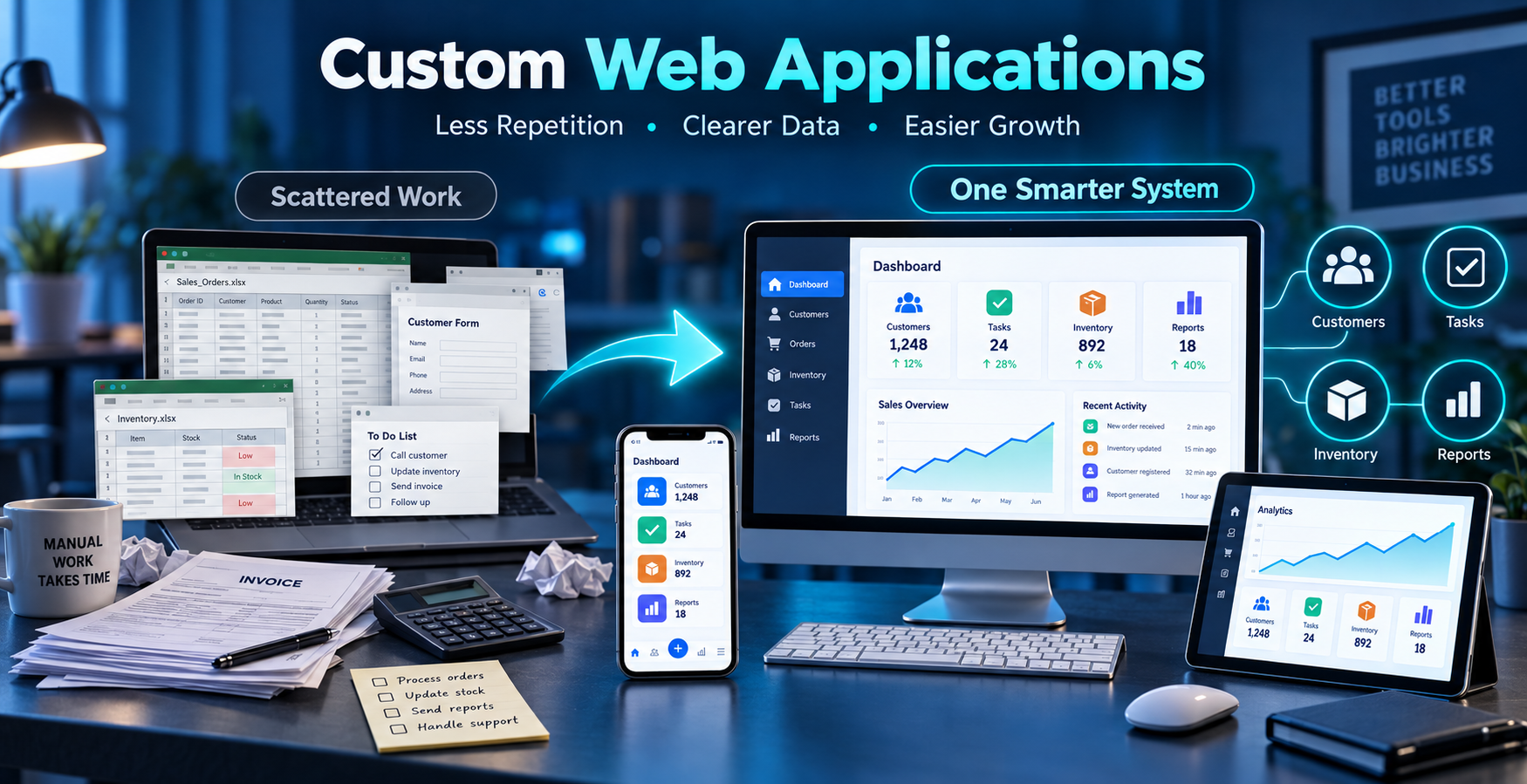
Spreadsheets are useful. They are familiar, flexible and often enough when a business is getting started.
But as customers, products, employees and transactions increase, the same files can become difficult to manage. Work gets repeated, information becomes scattered and simple reports begin taking longer than they should.
This does not mean every growing business immediately needs custom software. It means there may come a point when the current process creates more problems than it solves.
Here are seven practical signs to watch for.
Customer details may be in one sheet, payments in another and stock somewhere else. Your team spends time searching for information instead of using it.
A connected system can keep related records together and make them easier to find.
If customer, invoice or product information must be typed into several files, the process becomes slower and mistakes become more likely.
Software can allow information entered once to be used wherever it is required.
Sales follow-ups, payment reminders or approvals may be forgotten when they depend entirely on memory.
A structured system can assign responsibility, show the current status and provide reminders.
If every weekly or monthly report requires copying information from several sheets and checking totals manually, valuable working time is being lost.
A dashboard can prepare useful summaries from existing records.
Files named “final”, “latest” and “final-updated” usually create confusion.
A central database gives authorised users one current version of the information instead of several competing copies.
A small typing mistake can create incorrect stock, billing or customer records.
Software cannot prevent every mistake, but validation rules and guided workflows can reduce common data-entry errors.
A sheet that works for 50 customers may become difficult with 500. If every new product, employee or branch makes the process noticeably slower, your current system may no longer fit the business.
Not always.
If the workflow is simple and the team can comfortably manage it, spreadsheets may still be the sensible choice. Ready-made subscription software can also work well when your requirements are standard.
Custom development is worth considering when your workflow is specific, repeated manual work is slowing the team down or available software forces the business into an unsuitable process.
The decision should begin with the business problem—not with the technology.
A practical system should help your team:
The goal is not to make work more complicated. It is to make everyday operations clearer, more consistent and easier to manage.
Outgrowing spreadsheets is often a natural part of business growth. Before investing in software, identify where time is being lost, which mistakes happen repeatedly and what information your team needs most often.
Utkal Codeworks develops practical web-based business software around clearly defined requirements. If your current process feels scattered or difficult to track, we can help you review it and decide whether a custom solution would genuinely be useful.
No. They work well for simple records and early-stage processes. Problems usually begin when too many people, files or connected activities depend on them.
No. Subscription tools suit common requirements. Custom software is more useful when your workflow, reporting or user roles are specific.
Often, yes. The data should first be reviewed and cleaned to remove duplicates and inconsistencies.
Yes. Starting with the most important module is often more practical than building every feature at once.
Bring your current files, explain the daily workflow and list the common delays, mistakes and reports you need.