Laxmi Vihar, Bhubaneswar, Odisha
Founder-Led Website, Software & ERP Development in Bhubaneswar, Odisha

Tally or custom billing software? Compare cost, GST, stock, staff access and 3-year spend in rupees, and see when Odisha businesses should use both.
If you run a business in Odisha, your accountant probably uses Tally. Many CAs here do. So when billing software comes up, a common first question is, "Why not just use Tally?"
It's a fair question, and sometimes the answer is: you should. Tally is good at what it was built for, and a custom system costs more upfront.
But Tally was built for accounting. If the trouble in your business is somewhere else, like orders written on paper, stock that never matches, or staff calling the office to check prices, a bigger Tally licence won't fix it.
Here's how the two compare, what each costs over three years, and how to tell which one your business needs.
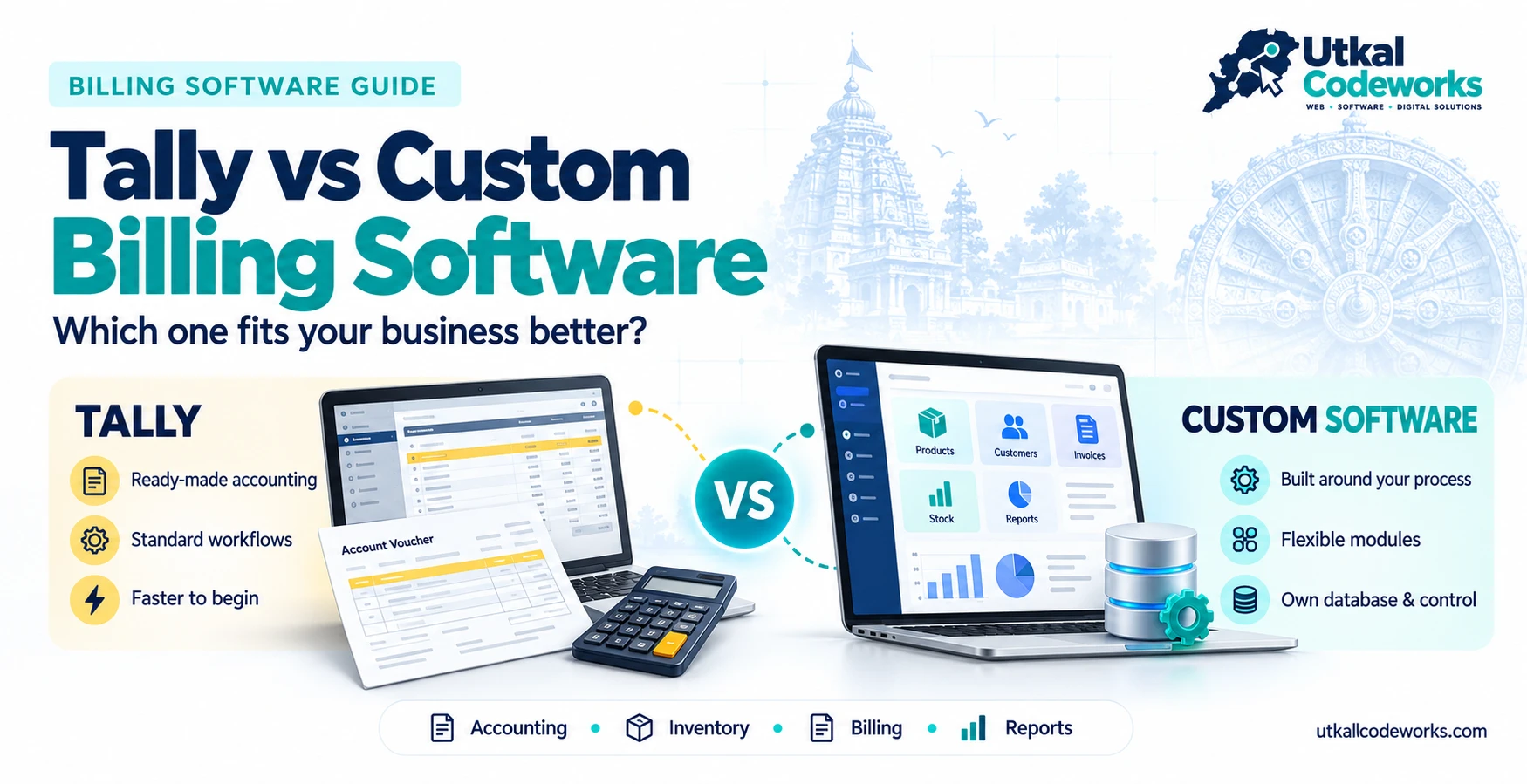
The short version: Tally is a ready-made accounting product. Custom software is built around how your business already runs. That one difference explains most of the table.
| TallyPrime | Custom billing software | |
|---|---|---|
| What it's built for | Accounting, GST, standard invoicing and inventory | Your own workflow: orders, stock, billing, staff tasks |
| Upfront cost | ₹22,500 (Silver) or ₹67,500 (Gold) + GST, or rent from ₹750/month | From ₹64,999 for a first version |
| Yearly cost | TSS renewal ₹4,500 (Silver) or ₹13,500 (Gold) + GST | Hosting (about ₹1,500–₹4,000) + optional maintenance |
| Setup time | Same day | A few weeks for a first version, depending on scope |
| GST invoices and returns | Strong, built in | GST invoices yes; returns usually still go through your CA |
| Screens and fields | Fixed; you adapt to Tally | Built around your process |
| Multiple users | Silver: one user. Gold: many users on a local network | As many as you need, each with their own role |
| Use on a phone or from another branch | Needs extra setup or a cloud add-on | Works in any browser by default |
| Customer or dealer login | No | Possible (order portal, statements, reorders) |
| Who knows how to use it | Most accountants already do | Your team learns it; it's built to be simple |
The Tally figures are from Tally Solutions' pricing guide, updated July 2026. Custom prices are our own starting prices from the packages page.
For a lot of small businesses, Tally does the job and there's no reason to spend more. It's probably the right choice if most of these sound like you:
A medical shop in Saheed Nagar, a hardware store in Cuttack or a small distributor with one warehouse can usually run well on Tally Silver. If you need several billing counters on one network, Gold covers that.
If this is you, spend the money on a proper Tally setup and some staff training instead of new software. That's the cheaper fix.
Custom software starts paying for itself when the problem isn't accounting. Watch for these signs:
If two or more of these fit, the post on 7 signs you've outgrown spreadsheets goes into more detail.
This is the setup we usually recommend. Keep Tally for accounts and GST returns, because your CA knows it and the books stay clean. Build the custom system for daily work: orders, stock movement, staff roles and reports.
Tally can import data from other software, so sales and purchase entries can be sent across at the end of the day instead of typed twice. Your staff get a system that fits the shop, and your accountant gets Tally files the way they like them.
Comparing only the first-year price is misleading, because Tally charges a yearly renewal and custom software costs most in year one. Here's the full three-year spend, before GST.
| Option | Year 1 | Years 2 and 3 | 3-year total |
|---|---|---|---|
| Tally Silver, rented | ₹8,100 | ₹8,100 a year | ₹24,300 |
| Tally Silver, lifetime licence | ₹22,500 | ₹4,500 a year (TSS) | ₹31,500 |
| Tally Gold, rented | ₹24,300 | ₹24,300 a year | ₹72,900 |
| Custom billing and inventory | ₹64,999 + hosting | Hosting, about ₹1,500–₹4,000 a year | About ₹69,500–₹77,000 |
| Tally Gold, lifetime licence | ₹67,500 | ₹13,500 a year (TSS) | ₹94,500 |
| Both: Tally Silver lifetime + custom | ₹87,499 + hosting | ₹4,500 + hosting a year | About ₹1,01,000–₹1,08,500 |
A few things the table doesn't show:
For a single-counter shop, Tally Silver is clearly cheaper. For a business that needs multiple users, the gap between Tally Gold and a custom system is smaller than most people expect.
Take a typical FMCG wholesaler in Cuttack. Two salesmen visit retailers around the city, there's one godown, and an accountant comes in three days a week.
Today the salesmen write orders in a notebook or send them on WhatsApp. In the evening, someone types them into Tally. Retailers call to ask what they owe. Stock in Tally rarely matches the godown, because returns and damaged goods get entered late.
Tally isn't the problem here. The problem is everything that happens before an entry reaches Tally.
A sensible fix would look like this:
The accountant keeps Tally. The owner gets one screen showing orders, stock and dues.
Answer these honestly:
If every answer is no, stick with Tally. If two or more are yes, a custom system, or custom software that feeds Tally, is worth pricing.
Our inventory and billing software guide covers the features to ask for and what a first version should include.
Not sure which way to go? Message us on WhatsApp with how your billing works today. We'll tell you plainly whether Tally is enough. If it isn't, we'll quote a first version from our inventory and billing solutions service, starting at ₹64,999, or you can start a project directly.
Not for everyone. Tally is better value when your needs are accounting, GST and simple billing from one place. Custom software is better when your daily operations, like orders, stock across locations or staff roles, don't fit Tally's fixed screens.
Yes. It can produce GST invoices with your GSTIN, HSN codes and tax breakup. Filing GST returns is usually still done by your CA, often in Tally.
Yes. Tally can import sales and purchase entries from other software, so invoices made in a custom system can go to Tally without retyping.
TallyPrime Silver costs ₹22,500 + GST for a lifetime licence or ₹750 a month to rent. Gold costs ₹67,500 + GST or ₹2,250 a month. Yearly renewal (TSS) is ₹4,500 for Silver and ₹13,500 for Gold, plus GST.
With us, a first version starts at ₹64,999, plus hosting of about ₹1,500–₹4,000 a year. You can start small and add modules later.